What are intangibles? - Intellectual capital model by Scandia
One of the first significant attempts of classifying and reporting the value of intellectual capital
 took place in 1994 by the group of specialists of Swedish financial service firm Scandia. At that time Professor Leif Edvinson was appointed as a world first Intellectual Capital Director at Skandia AFS. In 1994, Skandia began to publish a series of intellectual capital supplements to its financial accounting statement.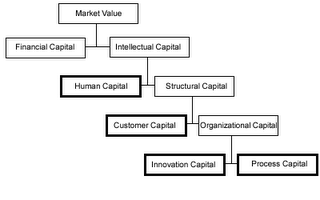
According to Skandia’s model market value of the company maybe divided into financial capital and intellectual capital. Financial capital is simply the company book value and contains all assets presented in traditional balance sheet. The rest of company value consists of intellectual capital that is subdivided into human capital and Structure Capital. What is important - human capital is not owned but rented and left company after 5 pm. On the contrary structure capital is the part that is still in the firm after 5 o’clock. This comprises corporate culture, management processes, IT systems, databases, reputation, brands and intellectual property. Naturally, that part of IC is controllable by the management and it is obvious that one of the main objectives of IC management is to move the value form human part to the structure. Skandia divided Intellectual capital more deeply into next layers. Entire intellectual capital classification according to Skandia is presented on the graph.
It is necessary to say that Skandia definition is not only one approach to the intangible assets described in literature. Many of them like MERITUM project have different approaches to that problem but have common elements. They tend to classify intangible as knowledge assets (such as those resulting from investments in R&D and often codified in patents), human capital, and organisational capital.
The European Union project on Measuring Intangibles to Understand and Improve Innovation Management (MERITUM) was funded within the framework of the Targeted Socio-Economic Research (TSER) programme between 1998 and 2001.
posted by Forty4 @ 7:56 AM
0 comments


0 Comments:
Post a Comment
<< Home